

What is Connected Speech?
When native English speakers talk quickly and naturally, words often don’t sound separate. They connect.
This natural flow of sounds between words is called connected speech. It makes English sound smooth, not choppy.
🎓 Learn English with the Blended method
Grupos reducidos · Tutor de IA disponible las 24 horas del día, los 7 días de la semana · Preparación para los exámenes de Cambridge
Planes de $39 $79 al mes
Why is Connected Speech Important for B1 Learners?
Understanding connected speech is very important for two main reasons:
- Listening: It helps you understand native speakers better. If you expect every word to be separate, you might miss what they say.
- Speaking: It makes your English sound more natural and fluent. You will sound more like a native speaker.
How Do Consonant and Vowel Sounds Link?
One of the most common types of connected speech is linking a consonant sound to a vowel sound.
- When a word ends with a consonant sound, and the next word starts with a vowel sound, we often connect them.
- There is no pause between the two words. The final consonant sound moves to the beginning of the next word.
- It's like the two words become one longer word.
Can You Show Me Some Examples of Linking?
Look at these examples. The consonant sound at the end of the first word links to the vowel sound at the start of the second word.
- What are: Sounds like Wha-tare
- Get up: Sounds like Ge-tup
- An apple: Sounds like A-napple
- Is anyone: Sounds like I-sanyone
- Could I: Sounds like Cou-dI
- Want a: Sounds like Wan-ta
- Your email: Sounds like You-remail
How Can I Practice Linking Sounds?
Practicing connected speech will make a big difference in your English.
- Listen carefully: Pay attention to how native speakers link words in songs, movies, and conversations. Try to hear the connections.
- Shadowing: Listen to a short audio clip and try to repeat it exactly as you hear it, at the same speed and with the same connections.
- Read aloud: Read English texts aloud, focusing on making your speech flow smoothly from one word to the next, especially when a consonant meets a vowel.
- Record yourself: Record your voice and listen back. Do you hear any pauses where there should be a link?
Ejemplos
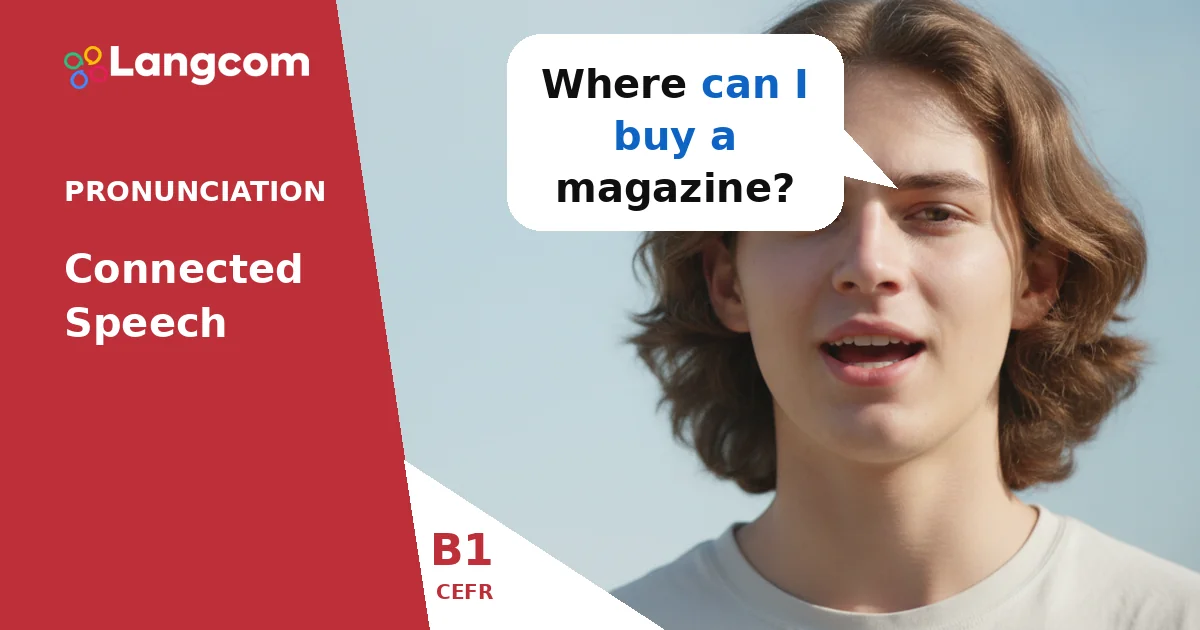
- Where can I buy a magazine?
- How much is a ticket?
- Is anyone sitting here?
- Could I sit next to you?
- What are you reading?
- Do you want a drink?
- Where do you get off?
- Can I have your email address?
Práctica
✍️ ¿No sabes en qué nivel estás?
Realiza nuestra prueba de nivel gratuita y recibe comentarios personalizados de examinadores certificados por Cambridge.
Realice nuestra prueba de nivel GRATUITAErrores habituales de los hispanohablantes
Spanish speakers sometimes make these common mistakes with connected speech:
- Adding extra vowel sounds: In Spanish, words often end with a vowel. In English, a word ending in a consonant followed by a vowel should link directly. For example, saying get (pause) up instead of getup.
- Not linking at all: Speaking every word separately, which can make your speech sound unnatural or robotic. For example, I (pause) am (pause) an (pause) English (pause) student instead of I'm an English student.
- Mispronouncing linked sounds: Sometimes, the linked sound might change slightly. Focus on the natural flow rather than forcing a specific sound.
Preguntas más frecuentes
Is connected speech a grammar rule?
No, connected speech is not a grammar rule. It is a feature of natural spoken English pronunciation. It describes how sounds change or link when words are spoken together quickly.
Do I always have to link words?
You don't always have to link words, especially if you are speaking slowly and clearly. However, linking is very common in natural, fast speech. Learning it will help you sound more fluent and understand others better.
Does linking change the meaning of words?
No, linking does not change the meaning of individual words. It only affects how they sound when spoken together. The meaning of the sentence stays the same.
What is the difference between linking and elision?
Linking is when sounds join together, like an apple. Elision is when a sound disappears completely, for example, the /t/ in don't know often disappears, sounding like don' know. Both are types of connected speech.



0 Comentarios