
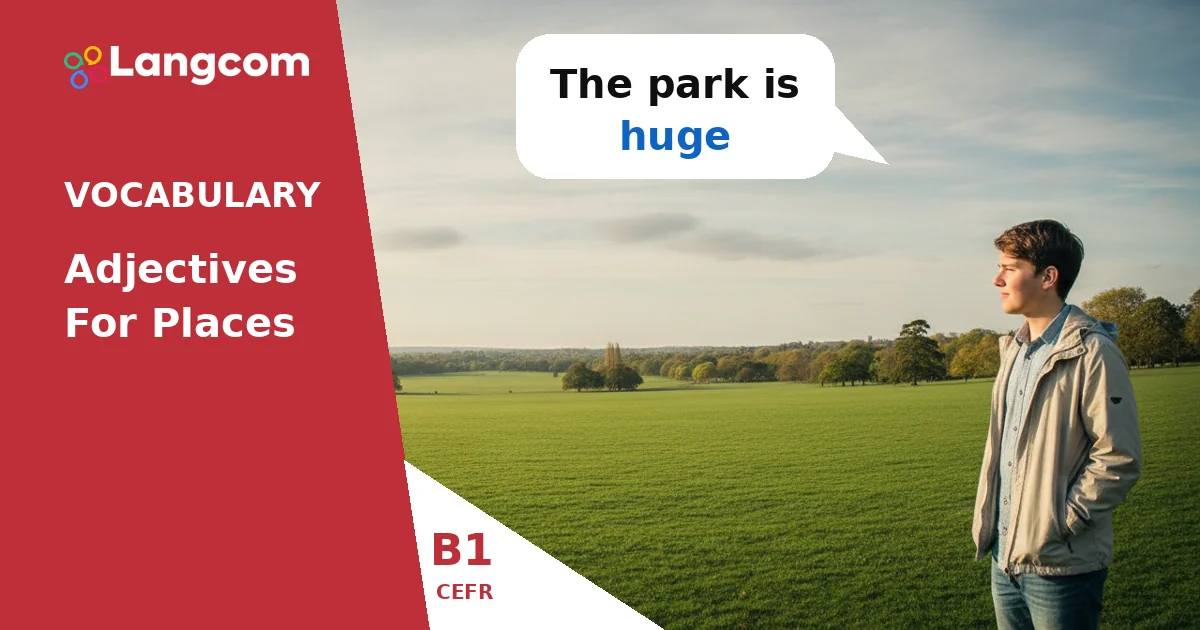

What are Adjectives for Places?
Adjectives are words that describe nouns. When we talk about places, adjectives help us paint a picture with words. They tell us what a place is like.
Using adjectives makes your English sound more natural and interesting. It helps others understand exactly what you mean when you describe a location.
🎓 Learn English with the Blended method
Grupos reducidos · Tutor de IA disponible las 24 horas del día, los 7 días de la semana · Preparación para los exámenes de Cambridge
Planes de $39 $79 al mes
How Do We Use Adjectives for Places?
Adjectives usually come before the noun they describe. This is a common pattern in English sentences.
- "It's a beautiful park."
- "The city is very crowded." (Here, the adjective comes after the verb 'to be'.)
You can use many different adjectives to describe places. Let's look at some common categories.
Describing Size and Space
These adjectives tell us about how big or small a place is, or how much space it has.
- Huge: Very, very big. "The stadium is huge."
- Tiny: Very, very small. "My apartment is tiny."
- Narrow: Not wide; small from side to side. "The street is very narrow."
- Wide: Broad; large from side to side. "The river is wide here."
- Spacious: Having a lot of space. "The living room is spacious."
Describing Atmosphere and Sound
These words help us talk about the feeling of a place or the noise level.
- Crowded: Full of people. "The market was crowded."
- Quiet: Making little or no noise. "The library is a quiet place."
- Noisy: Full of noise. "The cafe is too noisy for studying."
- Peaceful: Calm and quiet. "I love the peaceful countryside."
- Lively: Full of energy and activity. "The city center is very lively at night."
- Boring: Not interesting. "Some people find small towns boring."
Describing Appearance and Age
Use these adjectives to talk about how a place looks or how old it is.
- Pretty: Attractive in a delicate way. "The garden has many pretty flowers."
- Ugly: Unpleasant to look at. "Some old buildings can look ugly."
- Modern: Relating to recent times or current styles. "They built a modern shopping mall."
- Ancient: Very old. "Rome has many ancient ruins."
- Magnificent: Very impressive and beautiful. "The palace was magnificent."
- Ordinary: Not special or unusual. "It was just an ordinary house."
Describing Location Type and Condition
These adjectives help specify the type of location or its general state.
- Indoor: Located or happening inside a building. "We went to an indoor swimming pool."
- Outdoor: Located or happening outside. "The concert was held in an outdoor arena."
- Clean: Free from dirt. "The hotel room was very clean."
- Dirty: Not clean. "The old factory was dirty and abandoned."
- Safe: Protected from danger. "This neighborhood feels very safe."
- Dangerous: Not safe. "Some areas of the city are dangerous at night."
| Adjective | Opposite |
|---|---|
| Huge | Tiny |
| Crowded | Quiet / Empty |
| Pretty | Ugly |
| Modern | Ancient |
| High | Low |
| Indoor | Outdoor |
| Magnificent | Ordinary |
| Narrow | Wide |
| Noisy | Peaceful |
| Clean | Dirty |
| Safe | Dangerous |
Ejemplos
- The park is huge and has many pretty flowers.
- I prefer quiet places to noisy ones.
- The old town has narrow streets and ancient buildings.
- Our new office is very modern and spacious.
- The view from the mountain was absolutely magnificent.
- There's an outdoor market every Saturday.
- The beach was crowded with tourists during summer.
- She lives in a tiny house in a peaceful village.
Práctica
✍️ ¿No sabes en qué nivel estás?
Realiza nuestra prueba de nivel gratuita y recibe comentarios personalizados de examinadores certificados por Cambridge.
Realice nuestra prueba de nivel GRATUITAErrores habituales de los hispanohablantes
Common Mistakes with Adjectives for Places
Los hispanohablantes a veces cometen estos errores:
- Adjective Placement: In Spanish, adjectives often come after the noun (e.g., "un parque grande"). In English, adjectives almost always come antes de the noun.
- Wrong: "a park huge"
- Correcto: "a huge park"
- Using Adverbs Instead of Adjectives: Remember that adjectives describe nouns, while adverbs describe verbs, adjectives, or other adverbs.
- Wrong: "The city is beautifully." (Beautifully is an adverb)
- Correcto: "The city is beautiful." (Beautiful is an adjective)
- Confusing Similar Adjectives: Be careful with words that sound similar or have related meanings but are not interchangeable. For example, "quiet" (little noise) and "peaceful" (calm, free from disturbance). A place can be quiet but not necessarily peaceful if it feels tense.
Preguntas más frecuentes
What is an adjective for a place?
An adjective for a place is a word that describes a characteristic of a location. For example, "The city is lively" o "It's a modern building."
Can I use more than one adjective to describe a place?
Yes, absolutely! You can use several adjectives together to give a very detailed description. For example, "It's a small, quiet, peaceful village."
Do adjectives for places change form for plural nouns?
No, English adjectives do not change their form for singular or plural nouns. You say "a beautiful park" y "beautiful parks."
What's the difference between 'indoor' and 'outdoor'?
"Indoor" means inside a building, like an "indoor swimming pool." "Outdoor" means outside, like an "outdoor concert." They describe where an activity or place is located.



0 Comentarios